
Wood Elf Druid Names and Nature Traditions
A creative guide to druid names grounded in ecology, ritual, seasonal change, and personal vows.
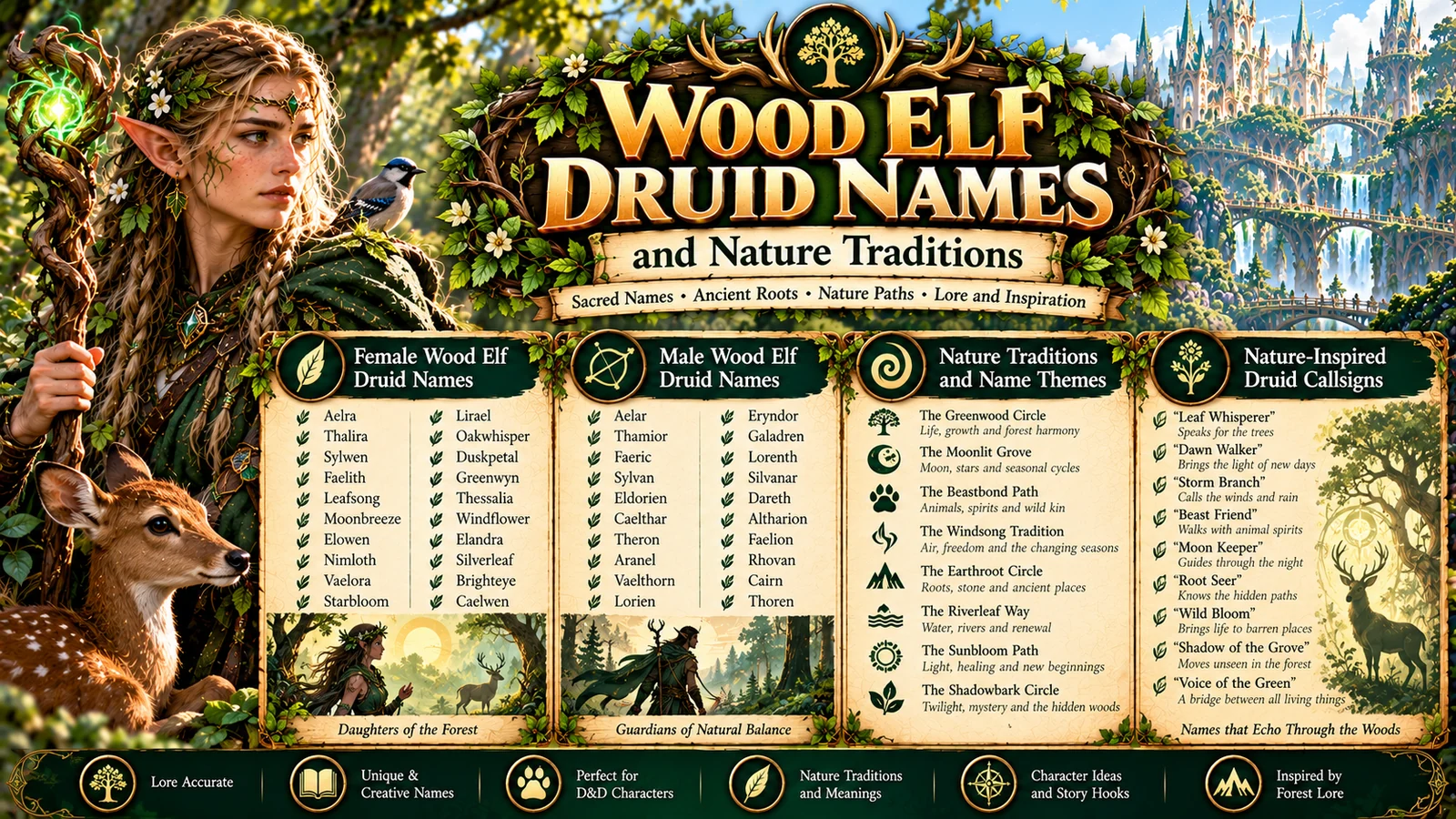
What this guide helps you decide
This guide focuses on ritual and responsibility. In practice, choosing a wood elf druid names means balancing a readable sound with the ecosystems the character protects and the cycles they observe. You will work through examples, examine alternatives, and finish with a name that can survive real use in dialogue, a roleplaying session, or a character database. The sample names are independently invented fiction; suggested interpretations describe imagined stories, not authenticated elvish translations.
Our working scenario follows a druid learning that protecting a forest sometimes means allowing it to change. We will revisit that idea throughout the guide so each choice has consequences: a name suitable for a ceremonial introduction may be awkward for a hurried warning, and a family name may matter more in a local dispute than on a journey. You can replace the scenario with your own character at any stage.
1. Seasonal titles
To work with seasonal titles, begin by asking what a listener needs to understand immediately. For wood elf druid names, that usually means a clear first-name rhythm, enough distinction from other characters, and a context that justifies the choice. A name should be specific to the story without requiring a paragraph of explanation every time it appears.
Imagine mushroom circles, river reeds, thawing soil, windfallen trees, and migrating birds. Instead of transferring every image directly into the name, choose one small connection. For example, a family based near a stream might use a place-derived surname; a scout could be known by a short trail title; a diplomat may prefer the family name in formal settings. The same sound can communicate very different things depending on who speaks it.
A practical test for seasonal titles: write three candidates, say each twice at conversational speed, and put the strongest one in a simple sentence such as “Have you seen ___ since dawn?” Eliminate a candidate if it creates confusion with another name or looks like a random stack of punctuation. If an option fails, change one syllable rather than starting from scratch.
2. Ritual naming
To work with ritual naming, begin by asking what a listener needs to understand immediately. For wood elf druid names, that usually means a clear first-name rhythm, enough distinction from other characters, and a context that justifies the choice. A name should be specific to the story without requiring a paragraph of explanation every time it appears.
Imagine mushroom circles, river reeds, thawing soil, windfallen trees, and migrating birds. Instead of transferring every image directly into the name, choose one small connection. For example, a family based near a stream might use a place-derived surname; a scout could be known by a short trail title; a diplomat may prefer the family name in formal settings. The same sound can communicate very different things depending on who speaks it.
A practical test for ritual naming: write three candidates, say each twice at conversational speed, and put the strongest one in a simple sentence such as “Have you seen ___ since dawn?” Eliminate a candidate if it creates confusion with another name or looks like a random stack of punctuation. If an option fails, change one syllable rather than starting from scratch.
3. Ecological accuracy
To work with ecological accuracy, begin by asking what a listener needs to understand immediately. For wood elf druid names, that usually means a clear first-name rhythm, enough distinction from other characters, and a context that justifies the choice. A name should be specific to the story without requiring a paragraph of explanation every time it appears.
Imagine mushroom circles, river reeds, thawing soil, windfallen trees, and migrating birds. Instead of transferring every image directly into the name, choose one small connection. For example, a family based near a stream might use a place-derived surname; a scout could be known by a short trail title; a diplomat may prefer the family name in formal settings. The same sound can communicate very different things depending on who speaks it.
A practical test for ecological accuracy: write three candidates, say each twice at conversational speed, and put the strongest one in a simple sentence such as “Have you seen ___ since dawn?” Eliminate a candidate if it creates confusion with another name or looks like a random stack of punctuation. If an option fails, change one syllable rather than starting from scratch.
4. Nature imagery
To work with nature imagery, begin by asking what a listener needs to understand immediately. For wood elf druid names, that usually means a clear first-name rhythm, enough distinction from other characters, and a context that justifies the choice. A name should be specific to the story without requiring a paragraph of explanation every time it appears.
Imagine mushroom circles, river reeds, thawing soil, windfallen trees, and migrating birds. Instead of transferring every image directly into the name, choose one small connection. For example, a family based near a stream might use a place-derived surname; a scout could be known by a short trail title; a diplomat may prefer the family name in formal settings. The same sound can communicate very different things depending on who speaks it.
A practical test for nature imagery: write three candidates, say each twice at conversational speed, and put the strongest one in a simple sentence such as “Have you seen ___ since dawn?” Eliminate a candidate if it creates confusion with another name or looks like a random stack of punctuation. If an option fails, change one syllable rather than starting from scratch.
5. Spirit names
To work with spirit names, begin by asking what a listener needs to understand immediately. For wood elf druid names, that usually means a clear first-name rhythm, enough distinction from other characters, and a context that justifies the choice. A name should be specific to the story without requiring a paragraph of explanation every time it appears.
Imagine mushroom circles, river reeds, thawing soil, windfallen trees, and migrating birds. Instead of transferring every image directly into the name, choose one small connection. For example, a family based near a stream might use a place-derived surname; a scout could be known by a short trail title; a diplomat may prefer the family name in formal settings. The same sound can communicate very different things depending on who speaks it.
A practical test for spirit names: write three candidates, say each twice at conversational speed, and put the strongest one in a simple sentence such as “Have you seen ___ since dawn?” Eliminate a candidate if it creates confusion with another name or looks like a random stack of punctuation. If an option fails, change one syllable rather than starting from scratch.
6. Life stage transitions
To work with life stage transitions, begin by asking what a listener needs to understand immediately. For wood elf druid names, that usually means a clear first-name rhythm, enough distinction from other characters, and a context that justifies the choice. A name should be specific to the story without requiring a paragraph of explanation every time it appears.
Imagine mushroom circles, river reeds, thawing soil, windfallen trees, and migrating birds. Instead of transferring every image directly into the name, choose one small connection. For example, a family based near a stream might use a place-derived surname; a scout could be known by a short trail title; a diplomat may prefer the family name in formal settings. The same sound can communicate very different things depending on who speaks it.
A practical test for life stage transitions: write three candidates, say each twice at conversational speed, and put the strongest one in a simple sentence such as “Have you seen ___ since dawn?” Eliminate a candidate if it creates confusion with another name or looks like a random stack of punctuation. If an option fails, change one syllable rather than starting from scratch.
A practical naming workshop: 10 worked examples
The following examples are invented starting points. Their imagined associations are creative prompts rather than claims about a real ancient or constructed language. For each one, try changing the location, profession, or family connection to see which elements remain convincing.
Example 1: Kaelis Quietbough
Kaelis Quietbough could belong to a forest guide who distrusts shortcuts who must reconcile an old feud between neighboring settlements. The surname hints at a shared place or family episode rather than a guaranteed dictionary meaning. It works especially well when the story explores ritual and responsibility; give the bearer one everyday habit that contrasts with the formal sound of the full name.
Editing experiment: focus on seasonal titles. Try “Kaelis” in a quick exchange, then use “Quietbough” as an address in a formal scene. If the two forms feel too similar to other characters, shorten the first name or exchange the surname for one tied to the ecosystems the character protects and the cycles they observe. Keep the version that is easiest to recognize after a reader has been away from the story for several chapters.
Example 2: Soriel Mosswake
Soriel Mosswake could belong to a caretaker of a narrow mountain pass who must choose between an inherited obligation and a personal promise. The surname hints at a shared place or family episode rather than a guaranteed dictionary meaning. It works especially well when the story explores ritual and responsibility; give the bearer one everyday habit that contrasts with the formal sound of the full name.
Editing experiment: focus on ritual naming. Try “Soriel” in a quick exchange, then use “Mosswake” as an address in a formal scene. If the two forms feel too similar to other characters, shorten the first name or exchange the surname for one tied to the ecosystems the character protects and the cycles they observe. Keep the version that is easiest to recognize after a reader has been away from the story for several chapters.
Example 3: Raviel Amberleaf
Raviel Amberleaf could belong to a apprentice mapmaker of old woodland trails who wants to preserve tradition without rejecting outsiders. The surname hints at a shared place or family episode rather than a guaranteed dictionary meaning. It works especially well when the story explores ritual and responsibility; give the bearer one everyday habit that contrasts with the formal sound of the full name.
Editing experiment: focus on ecological accuracy. Try “Raviel” in a quick exchange, then use “Amberleaf” as an address in a formal scene. If the two forms feel too similar to other characters, shorten the first name or exchange the surname for one tied to the ecosystems the character protects and the cycles they observe. Keep the version that is easiest to recognize after a reader has been away from the story for several chapters.
Example 4: Veylin Stoneleaf
Veylin Stoneleaf could belong to a witness to a village boundary dispute who needs to earn trust after a serious mistake. The surname hints at a shared place or family episode rather than a guaranteed dictionary meaning. It works especially well when the story explores ritual and responsibility; give the bearer one everyday habit that contrasts with the formal sound of the full name.
Editing experiment: focus on nature imagery. Try “Veylin” in a quick exchange, then use “Stoneleaf” as an address in a formal scene. If the two forms feel too similar to other characters, shorten the first name or exchange the surname for one tied to the ecosystems the character protects and the cycles they observe. Keep the version that is easiest to recognize after a reader has been away from the story for several chapters.
Example 5: Eshira Brookwarden
Eshira Brookwarden could belong to a keeper of a seasonal meeting place who is known by a title they no longer believe they deserve. The surname hints at a shared place or family episode rather than a guaranteed dictionary meaning. It works especially well when the story explores ritual and responsibility; give the bearer one everyday habit that contrasts with the formal sound of the full name.
Editing experiment: focus on spirit names. Try “Eshira” in a quick exchange, then use “Brookwarden” as an address in a formal scene. If the two forms feel too similar to other characters, shorten the first name or exchange the surname for one tied to the ecosystems the character protects and the cycles they observe. Keep the version that is easiest to recognize after a reader has been away from the story for several chapters.
Example 6: Rilena Nightbloom
Rilena Nightbloom could belong to a messenger between distant canopy hamlets who has a reputation shaped by a story that was only partly true. The surname hints at a shared place or family episode rather than a guaranteed dictionary meaning. It works especially well when the story explores ritual and responsibility; give the bearer one everyday habit that contrasts with the formal sound of the full name.
Editing experiment: focus on life stage transitions. Try “Rilena” in a quick exchange, then use “Nightbloom” as an address in a formal scene. If the two forms feel too similar to other characters, shorten the first name or exchange the surname for one tied to the ecosystems the character protects and the cycles they observe. Keep the version that is easiest to recognize after a reader has been away from the story for several chapters.
Example 7: Elowen Frostwillow
Elowen Frostwillow could belong to a herbalist who records weather changes who is preparing to leave a beloved homeland. The surname hints at a shared place or family episode rather than a guaranteed dictionary meaning. It works especially well when the story explores ritual and responsibility; give the bearer one everyday habit that contrasts with the formal sound of the full name.
Editing experiment: focus on seasonal titles. Try “Elowen” in a quick exchange, then use “Frostwillow” as an address in a formal scene. If the two forms feel too similar to other characters, shorten the first name or exchange the surname for one tied to the ecosystems the character protects and the cycles they observe. Keep the version that is easiest to recognize after a reader has been away from the story for several chapters.
Example 8: Sylara Silvergrove
Sylara Silvergrove could belong to a scout familiar with a flooded valley who is learning a skill their family considers unimportant. The surname hints at a shared place or family episode rather than a guaranteed dictionary meaning. It works especially well when the story explores ritual and responsibility; give the bearer one everyday habit that contrasts with the formal sound of the full name.
Editing experiment: focus on ritual naming. Try “Sylara” in a quick exchange, then use “Silvergrove” as an address in a formal scene. If the two forms feel too similar to other characters, shorten the first name or exchange the surname for one tied to the ecosystems the character protects and the cycles they observe. Keep the version that is easiest to recognize after a reader has been away from the story for several chapters.
Example 9: Elaris Cloudbranch
Elaris Cloudbranch could belong to a traveler who has adopted a new home who must reconcile an old feud between neighboring settlements. The surname hints at a shared place or family episode rather than a guaranteed dictionary meaning. It works especially well when the story explores ritual and responsibility; give the bearer one everyday habit that contrasts with the formal sound of the full name.
Editing experiment: focus on ecological accuracy. Try “Elaris” in a quick exchange, then use “Cloudbranch” as an address in a formal scene. If the two forms feel too similar to other characters, shorten the first name or exchange the surname for one tied to the ecosystems the character protects and the cycles they observe. Keep the version that is easiest to recognize after a reader has been away from the story for several chapters.
Example 10: Varen Moonbrook
Varen Moonbrook could belong to a guardian of an abandoned crossing who must choose between an inherited obligation and a personal promise. The surname hints at a shared place or family episode rather than a guaranteed dictionary meaning. It works especially well when the story explores ritual and responsibility; give the bearer one everyday habit that contrasts with the formal sound of the full name.
Editing experiment: focus on nature imagery. Try “Varen” in a quick exchange, then use “Moonbrook” as an address in a formal scene. If the two forms feel too similar to other characters, shorten the first name or exchange the surname for one tied to the ecosystems the character protects and the cycles they observe. Keep the version that is easiest to recognize after a reader has been away from the story for several chapters.
How to build a small naming system, not just one name
Step 1: Define a home region
Identify a river, ridge, grove, or road that influences local vocabulary. Families can share a landscape without sharing identical surnames. For wood elf druid names, compare this decision with your central concern of ritual and responsibility. Avoid treating invented syllables as genuine translations from Tolkien, D&D, or Elder Scrolls material unless you can point to an authoritative source.
Step 2: Choose two repeating sound patterns
Pick a handful of comfortable syllable endings and consonant pairs. Reuse them lightly across related characters; avoid forcing every name into a rigid formula. For wood elf druid names, compare this decision with your central concern of ritual and responsibility. Avoid treating invented syllables as genuine translations from Tolkien, D&D, or Elder Scrolls material unless you can point to an authoritative source.
Step 3: Decide when surnames are spoken
A close friend may use a first name while a council member uses a family name. This distinction can reveal tension without exposition. For wood elf druid names, compare this decision with your central concern of ritual and responsibility. Avoid treating invented syllables as genuine translations from Tolkien, D&D, or Elder Scrolls material unless you can point to an authoritative source.
Step 4: Add a reason for exceptions
An adopted traveler, a nickname earned during a journey, or a family that moved between regions can reasonably sound different. For wood elf druid names, compare this decision with your central concern of ritual and responsibility. Avoid treating invented syllables as genuine translations from Tolkien, D&D, or Elder Scrolls material unless you can point to an authoritative source.
Step 5: Test the naming system in dialogue
Put three names in one paragraph of speech. If a reader cannot distinguish who is being addressed, revise before expanding the cast. For wood elf druid names, compare this decision with your central concern of ritual and responsibility. Avoid treating invented syllables as genuine translations from Tolkien, D&D, or Elder Scrolls material unless you can point to an authoritative source.
Step 6: Record decisions in a style sheet
Keep spelling, pronunciation, nickname, relationship, and any invented meaning in one place. Consistency is more valuable than maximum complexity. For wood elf druid names, compare this decision with your central concern of ritual and responsibility. Avoid treating invented syllables as genuine translations from Tolkien, D&D, or Elder Scrolls material unless you can point to an authoritative source.
Common mistakes and how to repair them
Overcomplicated spelling
Replace decorative apostrophes or clusters with a pronounceable sequence. Unusual letters are not a substitute for character depth. The repair should support ritual and responsibility, not just make the page look decorative. Test the replacement in a scene where the character is doing something important.
Nature imagery without context
Choose the specific location or event behind the image. A surname is more memorable when another character can tell its story. The repair should support ritual and responsibility, not just make the page look decorative. Test the replacement in a scene where the character is doing something important.
Everybody sounds alike
Create contrast between generations, regions, and professions; similarity can imply kinship, but total sameness makes a cast hard to follow. The repair should support ritual and responsibility, not just make the page look decorative. Test the replacement in a scene where the character is doing something important.
Accidental claims about canon
Call original suggestions “inspired” or “invented,” not official lore. Check licensed game and book resources separately. The repair should support ritual and responsibility, not just make the page look decorative. Test the replacement in a scene where the character is doing something important.
Names that change spelling
Create a short style sheet and use one canonical spelling across drafts and character sheets. The repair should support ritual and responsibility, not just make the page look decorative. Test the replacement in a scene where the character is doing something important.
No spoken-language test
Read the name aloud in ordinary dialogue. Shorten or simplify if it interrupts the line. The repair should support ritual and responsibility, not just make the page look decorative. Test the replacement in a scene where the character is doing something important.
An editable character naming worksheet
- Character role: ____________________
- Homeland and environmental detail: ____________________
- Personal contradiction: ____________________
- Given name and simple pronunciation: ____________________
- Family or earned name: ____________________
- Nickname and who uses it: ____________________
- How the name changes in formal dialogue: ____________________
- Other cast names it must not resemble: ____________________
- Reason this name suits the story: ____________________
Use this worksheet after generating possibilities with the wood elf druid names tool. Do not automatically accept the first result. Select two or three candidates and compare them against the same character sheet so your judgment is consistent. Good names make writing and playing easier, not harder.
Questions readers often ask
Do the names have official meanings?
No. The sample meanings and associations in this guide are creative interpretations. They are not verified translations of a licensed fantasy language.
Can I use a suggested name in my own story?
You can use original suggestions as creative inspiration. Before commercial release, check whether a chosen combination is already strongly associated with an existing character or brand.
Should a wood elf name always reference nature?
No. Geography and ecology are useful motifs, but family history, personal values, local events, and social roles can be just as convincing.
How many names should I shortlist?
Three is often enough for a focused comparison. More can help during brainstorming, but select against character requirements rather than visual novelty.
How do I choose between two good names?
Read both in dialogue, check for conflicts with existing cast names, and choose the one that best supports how other characters address the person.
Next steps: turn a name into a believable character
Take the strongest option and write a short moment in which someone says it. Put the character under pressure, then let a second person use a different form of address. That two-line exchange reveals whether the name serves your story. For more candidates, open the wood elf druid names tool; for a wider framework, compare our other guides and worldbuilding resources.
Related reading: <a href="../../wood-elf-druid-name-generator/">Try the matching name generator</a> · <a href="../../guides/">Browse naming guides</a> · <a href="../../tools/">Explore all tools</a> · <a href="../">View all blog articles</a>.
Use our free interactive tool and save the candidates you like on your device.
Open the matching generator →